
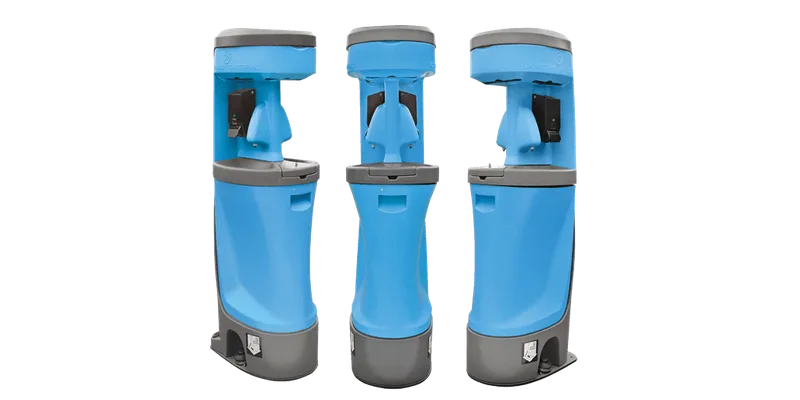
Identify the actual washing function and offered model
A usable portable washing arrangement needs appropriate clean water, soap, hand drying and used-water handling. Ask how the particular equipment operates and which positions people can use. Do not assume all stations have the same number of basins, control arrangement, supply method or usable space.
Hand sanitiser and a toilet’s flushing mechanism do not establish that complete washing function. Explain the activity and any relevant user requirements so the provider can assess an appropriate model. Specialist food or process requirements need their own responsible assessment; an ordinary handwashing request should not be presented as automatically satisfying them.
Compare usable positions, not only the number of housings
If the provider offers a station with more than one operating position, ask which positions can be used in the proposed layout. Compare that offer with separate stations where they are actually available. Two nominal positions may not work as intended if one side faces a boundary, conflicts with a door or cannot be approached by the people using it.
Neither option is inherently better for every group. A combined arrangement might suit people using one place, while separate supported positions might address different permitted activity areas. Have the provider assess the actual users and pattern rather than applying a guessed people-per-basin ratio or assuming more visible taps guarantee adequate provision.
Include access and continuing support in the comparison
Describe how people will reach and operate each position, including those who need a different approach or controls. Confirm suitable standing space and permission for the equipment. Do not describe a model as accessible from its size or a product label alone; the actual equipment and surrounding arrangement matter together.
Now check whether water and consumable replenishment, cleaning and used-water service can reach that layout. A position convenient for users should not leave the agreed support impossible. Identify who makes ordinary checks and reports missing supplies, and distinguish that role from provider servicing or repairs.
Put the selected washing arrangement into the offer
Ask the quote to identify the offered model, proposed number of stations and confirmed usable functions, together with the actual users, occupied period and positions. Include initial supplies, continuing water, soap and drying provision, cleaning and used-water care. There is no universal refill interval implied by the station count.
Agree delivery and collection, with a contact who can explain any change to the layout or use. If the event adds another activity area, ask whether the accepted arrangement still works before turning an unused-looking side into a new public position. Keep toilet provision and any other washing requirement distinct so no necessary function disappears between equipment orders.
Questions before you book
Does one station always provide one washing position?
Ask about the actual offered model and which operating positions are usable in the proposed layout; do not infer that from the number of housings.
Are separate stations always preferable?
No. Compare actual user patterns, permitted positions, model functions and continuing care for the confirmed offers.
Can a position be counted if people cannot reach it?
A nominal feature does not establish practical use. Discuss the approach and operating space with the property contact and provider.
What support belongs in the quote?
Clarify clean water, soap, drying supplies, cleaning, used-water handling, checks, transport and collection for the agreed use period.